The Waggon and the Schoolhouse
He was born into slavery on April 5, 1856, at Hale's Ford in Franklin County, Virginia, in a country already arguing itself toward war. His mother, Jane, worked the plantation kitchen. His father was a white man whose name was never spoken in the household. The boy learned letters by candlelight and a spelling book, and the Civil War arrived while he was still a child, bringing a freedom that the South would spend the next century trying to take back.
In 1872 he walked toward Hampton Normal and Agricultural Institute, a school founded to train Black teachers, and worked as a janitor to pay his way. The institution's founder, Samuel Chapman Armstrong, saw in him a man who could turn discipline into a public language. When Alabama created a new normal school for teachers in 1881, Armstrong recommended his former student. Booker Washington was twenty-five years old.
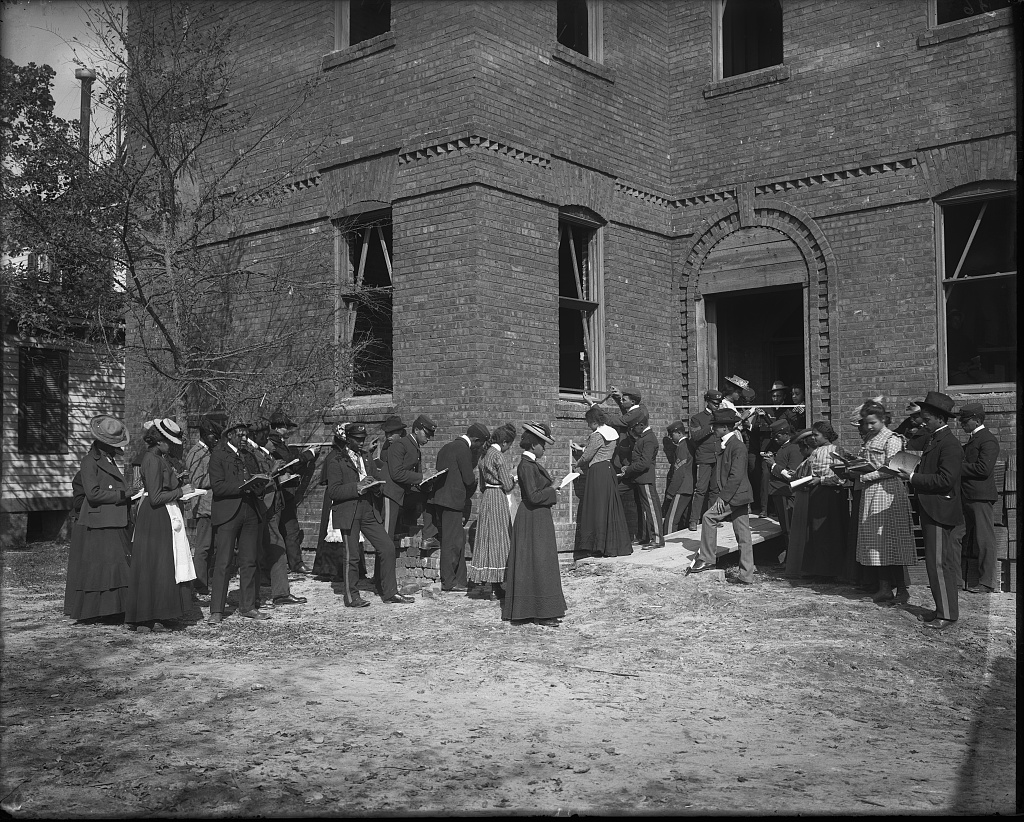
The school opened on July 4, 1881, in a shanty beside a church and a single donated room from Butler Chapel A.M.E. Zion, with about thirty students and no campus. What followed was less a founding than a long act of construction. Students built their own classrooms, fired their own bricks, and paid part of their tuition with labor. Learning and building were never separated at Tuskegee; the curriculum and the buildings grew from the same hands.
The photograph above shows that result: students holding notebooks outside a brick building the Institute's own workers had raised. Frances Benjamin Johnston, one of the most important American photographers of her era, made the glass negative around 1902 to 1906; the Library of Congress now holds it. She photographed the school for exhibitions, and her Tuskegee images were built to argue a point: that Black education was not a promise but a working institution.
Washington understood that an argument made of buildings travels farther than a speech. Donors wanted to see something before they gave, and the South wanted to be told it had not failed. Tuskegee offered both. The school became a machine for producing teachers, and teachers became a machine for producing schools. Within a generation the campus held hundreds of acres, a hospital, a farming department, and a reputation that reached Washington and London.
None of this happened gently. Every building required money that white philanthropists controlled, and every gift carried conditions no one wrote down. The young principal learned to speak a language his audiences wanted to hear while building something they could not easily stop. The waggon had carried him to Hampton. The schoolhouse would carry him somewhere far larger, and the distance between what he said and what he built would become the argument of his life.